Immigration Insights

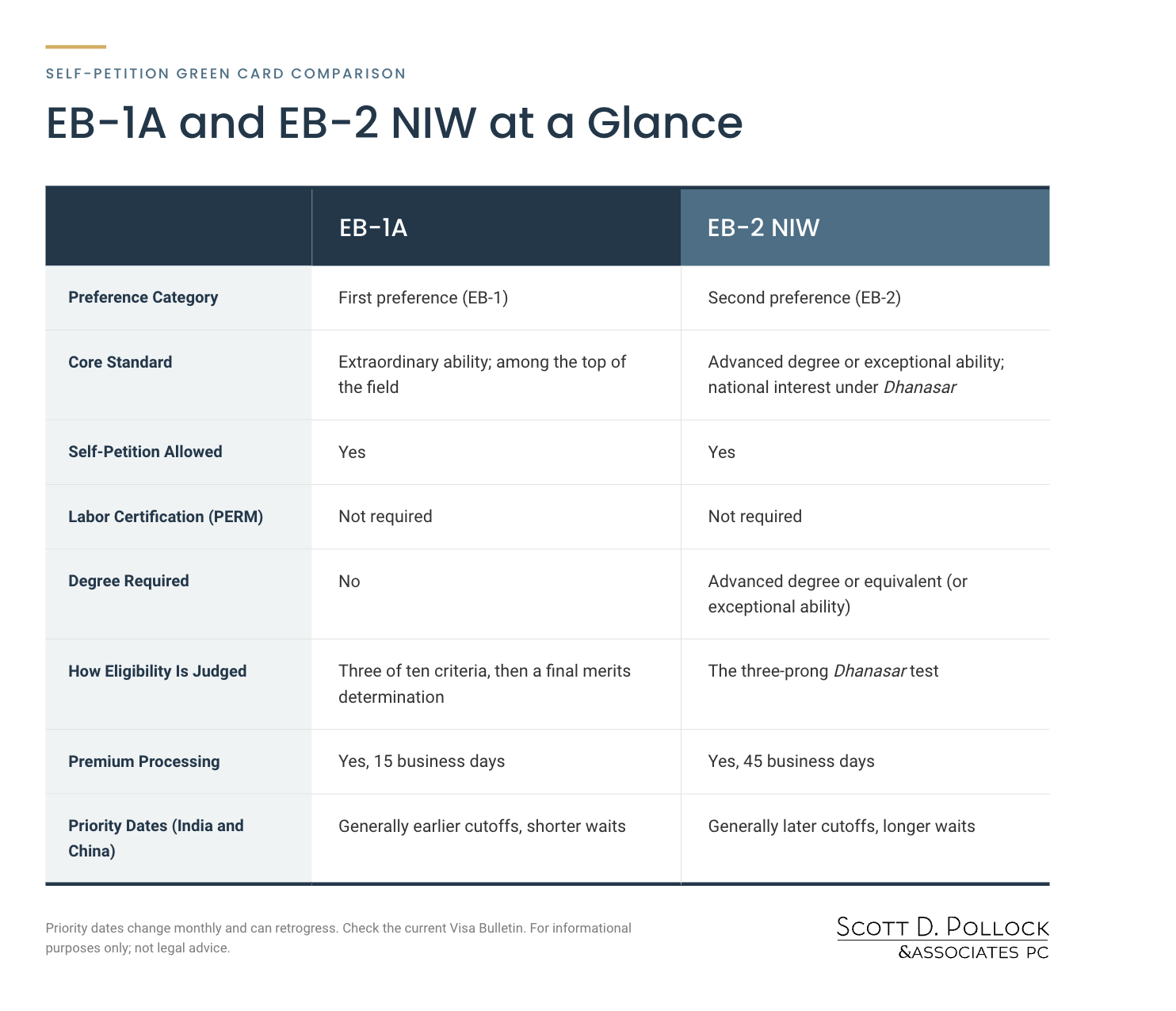
For a professional who can self-petition for a green card, the choice of EB-1A vs. EB-2 NIW generally comes down to which standard their record meets more convincingly. Both are employment-based immigrant categories that let a person file without an employer or a labor certification. The EB-1A, a first-preference category, requires extraordinary ability and recognition at the top of the field. The EB-2 national interest waiver, a second-preference category, requires an advanced degree or exceptional ability, plus a demonstration that the applicant’s work serves the national interest.
Applicants who qualify for one of these categories often nearly qualify for the other, which can make choosing between them complicated. This piece compares the two: their legal standards, their approval odds, and their typical processing and priority-date timelines.

The Difference in Standard
EB-1A: Extraordinary Ability at the Top of the Field
The EB-1A requires extraordinary ability, which USCIS treats as a level of expertise showing the applicant is among the small percentage at the very top of their field. A petition must satisfy at least three of ten regulatory criteria (awards, membership, published material about the applicant, original contributions of major significance, authorship, and others) or a single major internationally recognized award. It then faces a final merits determination, where USCIS weighs the whole record to decide whether the applicant genuinely holds that top-of-field standing with sustained acclaim.
EB-2 NIW: Advanced Degree Plus the National Interest
The national interest waiver starts from the EB-2 threshold (an advanced degree or exceptional ability) and then asks USCIS to waive the job offer and labor certification because the applicant’s work is in the national interest. Eligibility is judged on the three-prong Matter of Dhanasar test, demonstrating that the endeavor has substantial merit and national importance, that the applicant is well positioned to advance it, and that, on balance, it benefits the United States to waive the standard process. The NIW does not require top-of-field acclaim, which makes it achievable for many professionals who might not meet the EB-1A standard.

Approval Odds and Processing Times
Approval rates for both categories have changed a great deal. For the 2025 fiscal year, EB-1A approvals were higher than those of the national interest waiver (roughly 67% against 55%), but the gap narrowed and briefly reversed in early fiscal year 2026, when EB-1A approvals dipped below the NIW’s for a quarter. Both categories have seen denials rise sharply since 2022. In practice, what this means is that neither category is reliably “easier.”
Processing draws a clearer picture. Standard adjudication can take a long time for both – but for an additional fee (with Form I-907: Request for Premium Processing), premium processing shortens the wait to 15 business days for the EB-1A, whereas premium processing shortens the wait to 45 business days for the national interest waiver. Premium processing guarantees a decision within that window; it does not improve the odds of approval.
Priority Dates
For applicants from most countries, both categories are current, so priority dates do not favor one over the other. For applicants born in India or China, however, they can be decisive. Because EB-1 is a higher-preference category with its own annual allocation, its priority-date cutoffs are generally years ahead of EB-2 for these countries, meaning an EB-1A applicant may reach the green card stage well before an EB-2 NIW applicant with the same priority date. The gap has at times been very wide: EB-2 India has periodically been backlogged by more than a decade, and unavailable within a fiscal year, while EB-1 India, though also backlogged and subject to retrogression, has generally carried a much earlier cutoff.
These dates move every month and can retrogress without much warning, so the current Visa Bulletin is the only reliable reference. For an applicant who qualifies for both categories, the priority-date difference is often the single strongest reason to pursue the EB-1A over the EB-2.
Filing Both at Once
A person with a strong overall record may choose to submit both an EB-1A petition and an EB-2 NIW petition. If the EB-1A is denied, the NIW may still be approved; and for applicants born in India or China, an approved EB-1A can capture an earlier priority date.
However, because filing both means submitting Form 1-140 twice (with two filing fees and two evidence packages), it is not the right move for everyone. Whether it makes sense depends on how the record maps to each standard, which is part of what a case assessment with an immigration attorney can address.

Which Path Fits Your Profile
As a general guide, the EB-1A best suits applicants whose records clearly demonstrate independent recognition at the top of a field – citations, media, selective awards, and central roles that establish acclaim. The national interest waiver fits strong professionals whose work has clear national importance but who do not have top-of-field acclaim.
Many profiles fall in between, qualifying comfortably for neither or plausibly for both, and that is where a conversation with an immigration attorney can be helpful. These categories reward different evidence, and the same person can have a strong EB-1A case and a weak NIW case, or the reverse.
Frequently Asked Questions
Can I file EB-1A and EB-2 NIW at the same time?
Yes. The two categories rest on different standards and are filed on separate I-140 petitions, so an applicant with a strong record can pursue both in parallel. However, it requires two filing fees and two evidence packages, so it is not the right approach for every case.
Which has a higher approval rate, EB-1A or the NIW?
It depends on when you look. EB-1A approvals were higher than the national interest waiver for the 2025 fiscal year (roughly 67% against 55%), but the gap narrowed and briefly reversed in early fiscal year 2026. Approval in both categories has become more difficult to attain since 2022. Because these rates measure decisions across all applicants rather than the odds for a specific petition, the strength of a particular record matters far more than the general approval percentage.
Which has shorter wait times?
The EB-1A generally has shorter priority-date waits than the EB-2 NIW for applicants born in India or China, because EB-1 is a higher-preference category with earlier cutoff dates. For applicants from most other countries, both categories are typically current, so wait times are similar. Priority dates change monthly and can retrogress, so the current Visa Bulletin is the reliable reference.
Do both let me self-petition without an employer?
Yes. Both the EB-1A and the EB-2 national interest waiver allow for self-petition, meaning the applicant can file on their own behalf without an employer sponsor and without the PERM labor certification that a standard employment-based green card requires.
Does living in Illinois affect my EB-1A or NIW petition?
No. Both EB-1A and EB-2 are governed by federal law, so where you live within the United States does not change the standard or how USCIS adjudicates your petition.


Decide Between EB-1A and the NIW With Our Attorneys
The employment-based immigration attorneys at Scott D. Pollock & Associates, P.C. have over three decades of experience in immigration and nationality law, including extraordinary-ability and national interest waiver petitions.
To discuss which category fits your case, or whether to pursue both, call 312.444.1940 or fill out our online contact form to schedule a consultation.
View Similar ArticlesFor questions and/or to arrange a consultation with one of our attorneys contact us now